Links / Publishing
-
Henry Desroches makes the case for building and maintaining your own, personal website, rather than publishing one a few of the monolithic platforms of the web.
Monolithic platforms like YouTube, TikTok, Medium, and Substack draw a ton of creators and educators because of the promise of monetization and large audiences, but they’ve shown time and time again how the lack of ownership creates a problem. When those platforms fail, when they change their rules, when they demand creators move or create a particular way to maintain their access to those audiences, they pit creators or their audiences against the loss of the other.
I care deeply about (independent) online publishing, though I need to improve my own presence and make proper use of Webmentions and POSSE. However, Henry’s essay resonated, and I think will provide a great place to start, or a great reason why to start, for many.
Whatever you do, don’t use Substack.
-
The same reason you would bake a batch of cookies: because you enjoy it—the process itself, but also the result.
Make websites because you like to.
-
Philip Bump, previously a national correspondent at The Washington Post, on the question of whether you can positively influence, say, X’s direction by staying on it, as some are arguing.
Since I left The Washington Post, this question has guided my discussions with people interested in my writing for them. I’ve had numerous offers to write that I have (hopefully respectfully) declined. I’ve done so largely because I am trying to be conscientious about the prior question, to work with and for institutions that are directing their accrued power responsibly.
He goes on to say that this is why he doesn’t use Substack, and I wish more people would follow his example.
-
Ghost 6.0
№ 81My ex-colleagues at Ghost just released Ghost 6.0, a major update to their publishing software that includes networked publishing and native analytics.
Ghost publications are now connected with an open network. People can discover, follow, like and reply to your posts across Bluesky, Flipboard, Threads, Mastodon, WordPress, Ghost, and any other social web platform. Distribution is now built-in.
And,
We’re introducing a native analytics suite for Ghost, giving you detailed insights into how your content performs across web traffic, newsletters, and member subscriptions - all in real-time, all from the same place you publish everyday.
Alongside many other improvements, these changes mark a significant milestone for Ghost, and I’m especially keen to see how their integration with the open web evolves.
Give it a whirl with a free trial.
-
I’ve been banging this drum for a while, and will continue doing so, even after leaving my role at Ghost: Substack is not a place for independent writers.
John Gruber offers up a few examples of Substack’s branding trap.
But now they’ve gotten people to call publications on Substack not “blogs” or “newsletters” but “substacks”. Don’t call them that. And as I griped back in December, even the way almost all Substack publications look is deliberately, if subtly, Substack-branded, not per-publication or per-writer branded.
If you’re on Substack, and are now wondering if, why and how you should leave: here’s a neat little resource.
-
The Onion’s process is deeply, beautifully inefficient. Every day, our writers take 150 headlines into a physical writers room in Chicago and whittle them down to maybe one or two. These people throw away the funniest sentence I will ever write in my life six times by noon every weekday.
A great chat with Ben Collins, chief executive of The Onion, how they’re “thriving by saying what others won’t—and why human-created satire matters in a media landscape increasingly saturated by noise and A.I. slop” on Status.
You have to subscribe (for free) to read it, and it’s worth it.
-
The open web can be the future of publishing if we put our minds to it!
Mathew Ingram on publishing tools versus publishing platforms, and why Substack shouldn’t be seen as the future of online publishing. He also quotes from Ana Marie Cox’s recent piece, Substack Did Not See That Coming, which has been lingering in the back of my mind for a while.
Everything suspect about Substack stems from a desire to be more like a sticky destination and less like a publisher. You can ignore their posturing about free speech and just look at how they’re leaning harder and harder into audience capture and engagement. They’re offering audio, video, short-form posts, “discoverability.” They want to keep readers in their app listening, watching, interacting—anything but reading newsletters in their inbox as God intended.
-


The world’s most popular book on art is the topic of my book club this month. I’ve never read it (shame on me), and had to choose between a paperback version or this large, clothbound luxury edition. Easy decision.
This luxury edition, with its bespoke cloth cover and preface by Professor Gombrich’s granddaughter Leonie, is the ultimate gift purchase for all art lovers – a keepsake to treasure, and to inspire future generations.
-
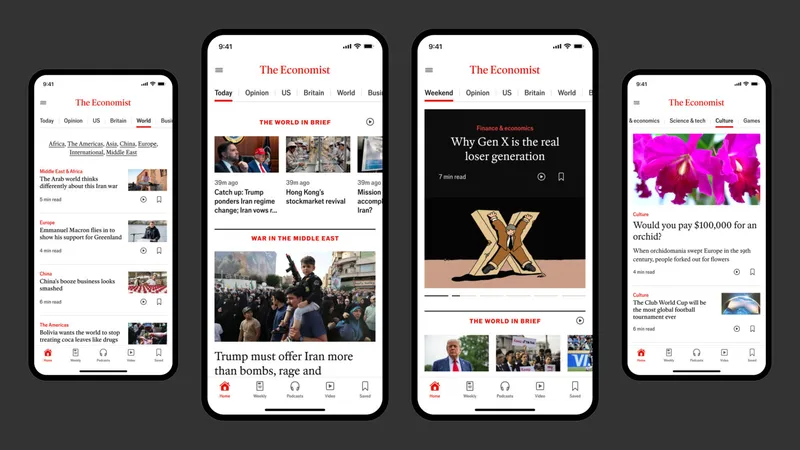
The Economist app’s Home tab layout will change depending on whether it’s a week or weekend day, in an attempt to fix their “relatively leaky bucket” and retain subscribers.
During the week, the app will lead with a horizontal top stories bar called “The World in Brief,” followed by the day’s latest stories and vertical videos. On the weekends, “The World in Brief” will be pushed further down and the Home tab will promote longer, in-depth stories and opinion and culture writers while a Weekly tab will highlight stories from the week’s print edition.
I’m curious if this approach will work. I seek out longer reads on weekends (in whatever news apps I’m using), but I also save them for the weekend throughout the week, and I can’t admit to ever having achieved inbox zero.
-
"This site explores the graphic design of Penguin book covers, with a focus on series editions. […] The covers presented on this site are all from my own collection of about 1.400 Penguins, which have been chosen for the beauty or interest of their cover designs. They span the history of the company all the way back to 1935 when Penguin Books was launched."
What a collection—beautiful.