Links
A regularly updated collection of things I find worth reading, watching, or listening to. Subscribe via RSS.
-

Photo by Obsidian, image editing by The Verge Steph “kepano” Ango, the CEO of Obsidian, was interviewed by Casey Newton for Decoder. I appreciate how he—and in turn, Obsidian—thinks about building their product. They’re a small team and, while they’re ambitious, they’re not looking to raise (or make) hundreds of millions of dollars.
We’re not trying to take over the world. We’re not trying to be the next Microsoft. That makes it a lot easier to make long-term decisions that we feel are better for ourselves or for our users. It’s the tool that we want to use all day long. So, it’s okay if people leave.
Obsidian uses Markdown, and all files are local. That means you can take them wherever you go, or even edit them in whichever tool you prefer. It’s no walled garden, and if Obsidian the company ever ceases to exist, your files are fine.
I know Kepano has been on this line of thinking for a long time. I remember researching similar things years ago and stumbling upon his thinking on File over app, which is a philosophy I can get behind.
I’ve started using Obsidian this summer and while the UI is a tad clunky for my taste, I can appreciate the system they’ve created. There’s a lot to appreciate in the interview, too; on note-taking, file systems, design, and AI, among other things.
-
They hardly ever miss at McSweeney’s.
I would like to address the recent slander circulating on social media, in editorial Slack channels, and in the margins of otherwise decent Substack newsletters. Specifically, the baseless, libelous accusation that my usage is a telltale sign of artificial intelligence.
Listen here, my good bitch.
-
Loren Stephens
№ 89Loren Stephens is eighty years old, and he blogs. His blog runs on Eleventy and Netlify, and he speaks to Manuel Moreale about his life since retirement, his blogging, and his creative environment. It’s all very straight-forward, and ... isn’t that kind of the point?
I quickly subscribed via his RSS feed. He’s had a few good posts up recently (1, 2).
-
A post from Cory Dransfeldt (from January of 2024) on the fracturing of social media, and the opportunity it’s presented for the personal web.
Call it the indie web, the small web or the slow web. Do or don’t label it—buy a domain, stand up a site, write and share. Find other folks doing it—maybe on Mastodon, maybe on another network, protocol or application—find out who they’re following and look at their sites. See what they’ve linked to and are reading.
I don’t remember where I found the post, but it comes at an opportune moment, as I’ve been investing lots of time in my personal website in the past two months, have rekindled my usage of RSS feeds, and found quite a few great blogs to follow. And, I just finished setting up syndication to Bluesky, bringing me one step closer to POSSE.
-

Sunflower Sound System by Sam Shepherd (Floating Points). Photo by Angelina Nikolayeva Sam Shepherd (known as Floating Points) has built a massive sound system, consisting of eight giant cabinets and a handful of tweeters hung from the ceiling. This video from Resident Advisor shows the build, and Jeremy D. Larson wrote about it on Pitchfork. He visited Dekmantel (which quite literally happens in my backyard), where the sound system was installed at The Greenhouse Stage. I wish I had been there to experience it!
-
Usable Google Fonts
№ 86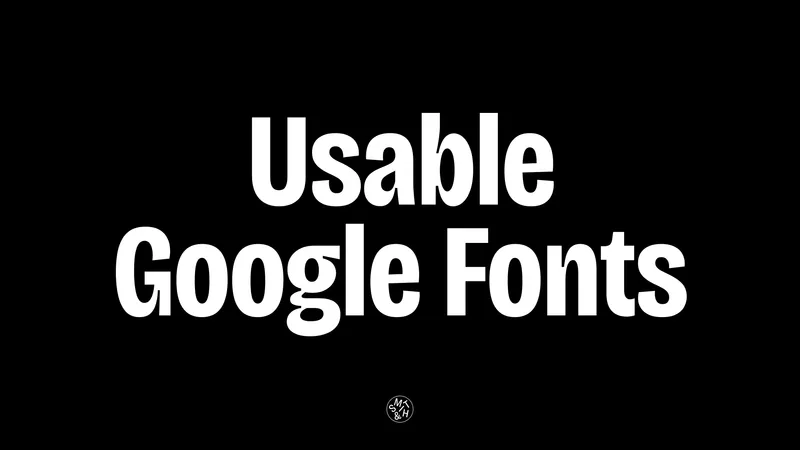
Mike of Smith & Diction put together this useful resource, in the form of a Figma file, for picking... well, ... usable Google fonts. Take your pick!
Thanks for sharing, Cameron.
-

The album I didn’t know I needed: Radiohead just released live recordings from their Hail To The Thief era, a somehow, somewhat impopular album of theirs that I love.
Thom Yorke said about it:
In the process of thinking how to build arrangements for the Shakespeare Hamlet/Hail to the Thief theatre production I asked to hear some archive live recordings of the songs. I was shocked by the kind of energy behind the way we played and it really helped me find a way forward. For us, back in the day, the finishing of this record was particularly messy and fraught, we were very proud of it but there was a taste left in our mouths, it was a dark time in so many ways. Anyway we decided to get these live recordings mixed (it would have been insane to keep them for ourselves) by Ben Baptie, who did an amazing job. It has all been a very cathartic process, we very much hope you enjoy them.
This’ll go into my heavy rotation immediately. The energy of this performance of There, There in Buenos Aires alone is tremendous.
-

While designing a bit of UI, I was trying to find out how to type the interpunct symbol (·) on a Mac (alt + shift + 9), and found this fun, geeky little resource by type.today. They have a few different manuals up on the site that go into typographic details on things like quotation marks, spaces, dashes, brackets, and other characters you may not know a lot about. If you like type, this is a fun read.
-
Sticking With It
№ 83Manuel Moreale on sticking with software.
I coded this blog on Kirby back in 2017, and it’s still on it, 8 years later. I’m writing this blog post using IA Writer, an app I’ve been using since April 2012. That’s more than 13 years ago. And the same story applies to pretty much all the apps I use the most: I’ve been using Sublime Text since 2013, Transmit since 2016, and Codekit since 2014.
What he loves about sticking with tools, or software, for the long run, is that he gets to know the people behind them. I can appreciate that. I for one am just glad when people make well-designed software that is built to last; when they charge for it from day one, and are able to continue putting time and effort into developing or maintaining it.
Software I’ve used (and paid for) for years includes iA Writer, Todoist and Lunch Money (referral link). Letterboxd too, although that’s more a social network, less a tool.
My last site ran on Framer for three-ish years. Let’s see if this one, coded with Eleventy, is around in this shape five years from now.
-
Temper Studio
№ 82
Photo by Manuel Peric A friend recently forwarded me Temper Studio, a new tennis brand dropping one product per month during their “rookie season”. As a somewhat obsessive tennis player, I’m a sucker for this (I don’t need these things, but maybe I do?), and my finger’s been hovering over the purchase button for a while now.
The main reason I’m linking to them here is their photography. They were taken by Manuel Peric, and they’ve clearly put a lot of thought and effort into creating photos that make you feel the game; a breath of fresh air in a time where many are trying to cut corners and using AI to produce similar (yet soulless) imagery.
I love how they presented their ball collector, in all its glory.